

.pte program, and runs it on phones, single-board computers, and microcontrollers with backends such as XNNPACK and CMSIS-NN.
In this tutorial, you’ll connect PyTorch to Edge Impulse with two custom blocks: a learning block that trains a model and exports both ONNX (for Studio) and an ExecuTorch .pte, and a deployment block that packages a trained impulse into a .pte with a small runtime harness. At the end, you’ll have a reusable PyTorch-to-edge pipeline in your own organization.
This tutorial uses the Edge Impulse CLI and Docker. Install the Edge Impulse CLI and Docker before you start.
How the blocks fit together
Edge Impulse works with TensorFlow, TFLite, and ONNX, while ExecuTorch consumes PyTorch programs. The two blocks bridge that gap at different stages of the pipeline.
The learning block is available to all users. The deployment block is an enterprise feature.
1. Train a PyTorch model with a custom learning block
The learning block trains a compact CNN on your project’s image data and outputs an ONNX model that Edge Impulse converts to TFLite for deployment.This walkthrough uses the image classifier (executorch-pytorch-classification-block). The same block ships in four modality variants: image, audio (keyword spotting), time-series, and object detection. See Source code for all of them; the steps below are identical, only the input data and
parameters.json differ.Block structure
The block contains the standard custom learning block files:parameters.json file declares the block as a machine learning block that operates on images and expects pixels scaled to 0..1:
Handle the data format
Edge Impulse provides image data as pre-scaledfloat32 arrays in NHWC (batch, height, width, channels) order. PyTorch expects NCHW, so the training script transposes the arrays before training:
Export ONNX and ExecuTorch
After training, the block writesmodel.onnx for Studio and, when the --export-pte flag is set, an ExecuTorch program:
executorch==0.4.0 requires torch==2.5.0. Pin the two together and install the CPU wheels from https://download.pytorch.org/whl/cpu to avoid pulling CUDA packages into the build.Test the block locally
Download processed data from a project that has an image impulse, then run the container:out/model.onnx and out/model.pte when the run finishes.
Push to Edge Impulse
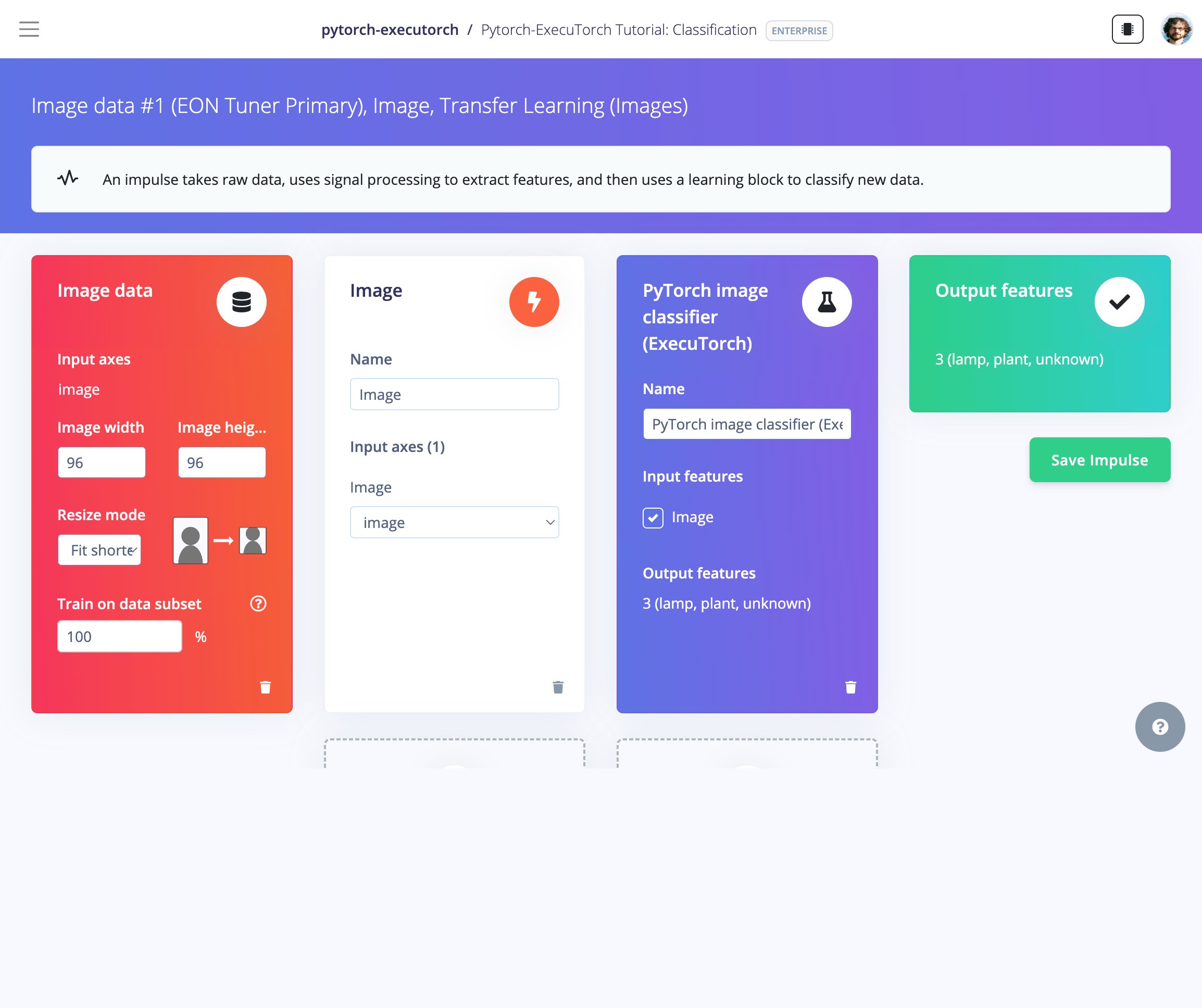
The ExecuTorch learning block added to an image impulse in Studio
Train and test in Studio
With the block added to your impulse, train it from the Learning page, then verify it generalizes on the Model testing page.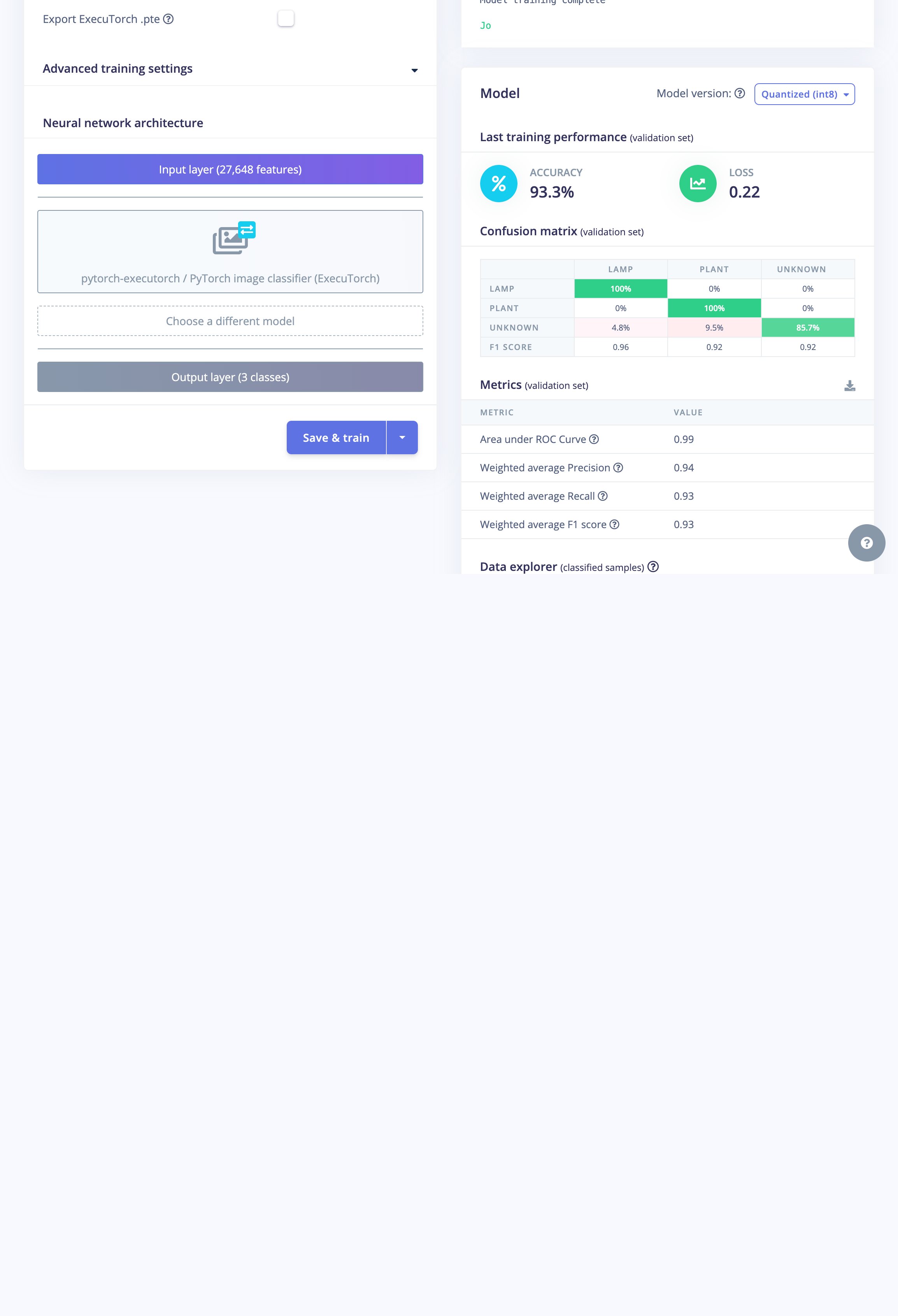
Training the PyTorch classifier (93.3% validation accuracy)
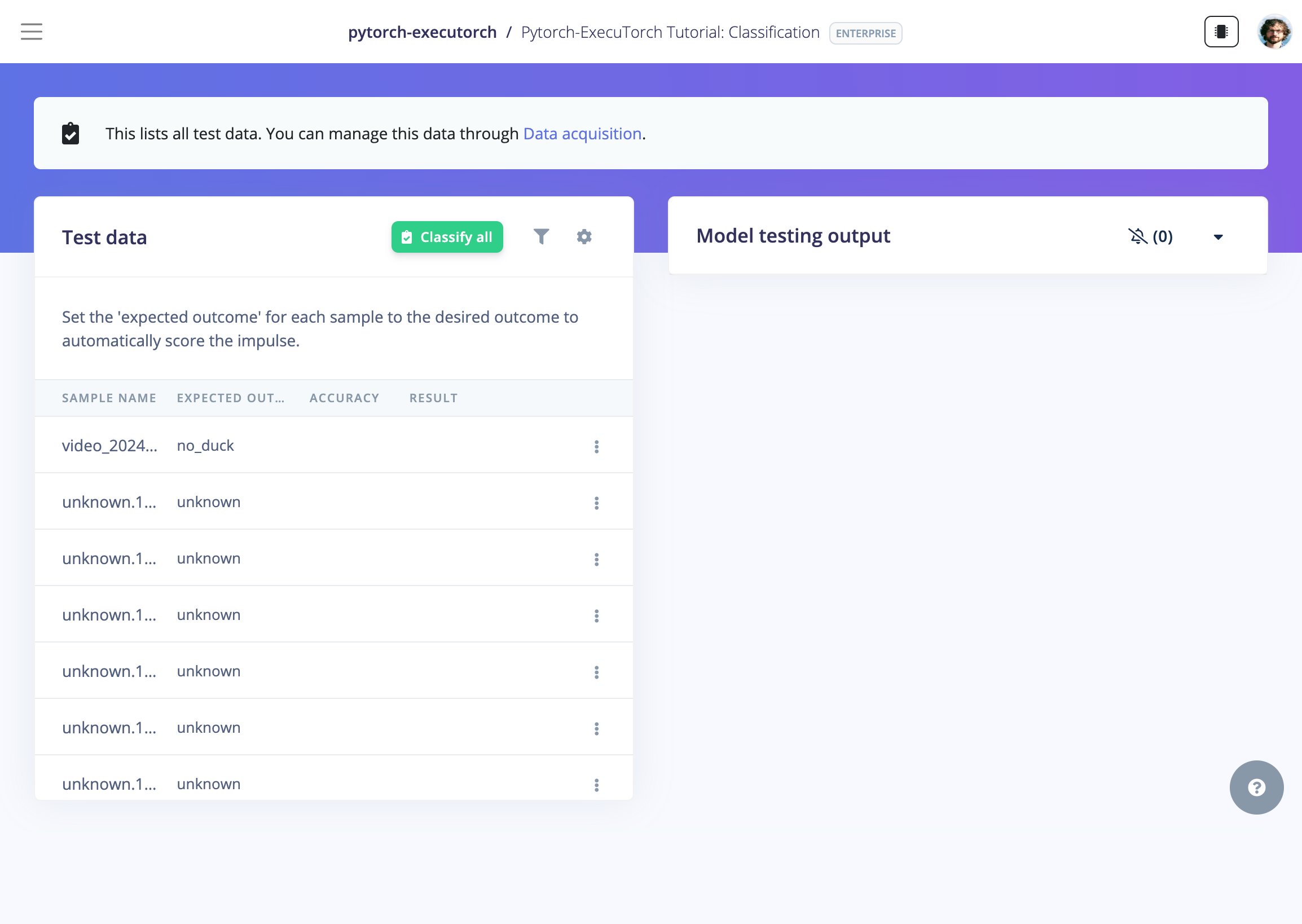
Model testing on the held-out test set
2. Export to ExecuTorch with a custom deployment block
Only available on the Enterprise planThis feature is only available on the Enterprise plan. Review our plans and pricing or sign up for our free expert-led trial today.
onnx2torch, then lowers it to a .pte. The full source is in executorch-deploy.
Block structure
deployment-metadata.json, which points to the input and output folders:
deploy.zip to the output folder. See deployment-metadata.json for the full input schema.
Test the block locally
deploy.zip contains model.pte, the source model.onnx, labels.txt, and the app/ harness.
Push to Edge Impulse
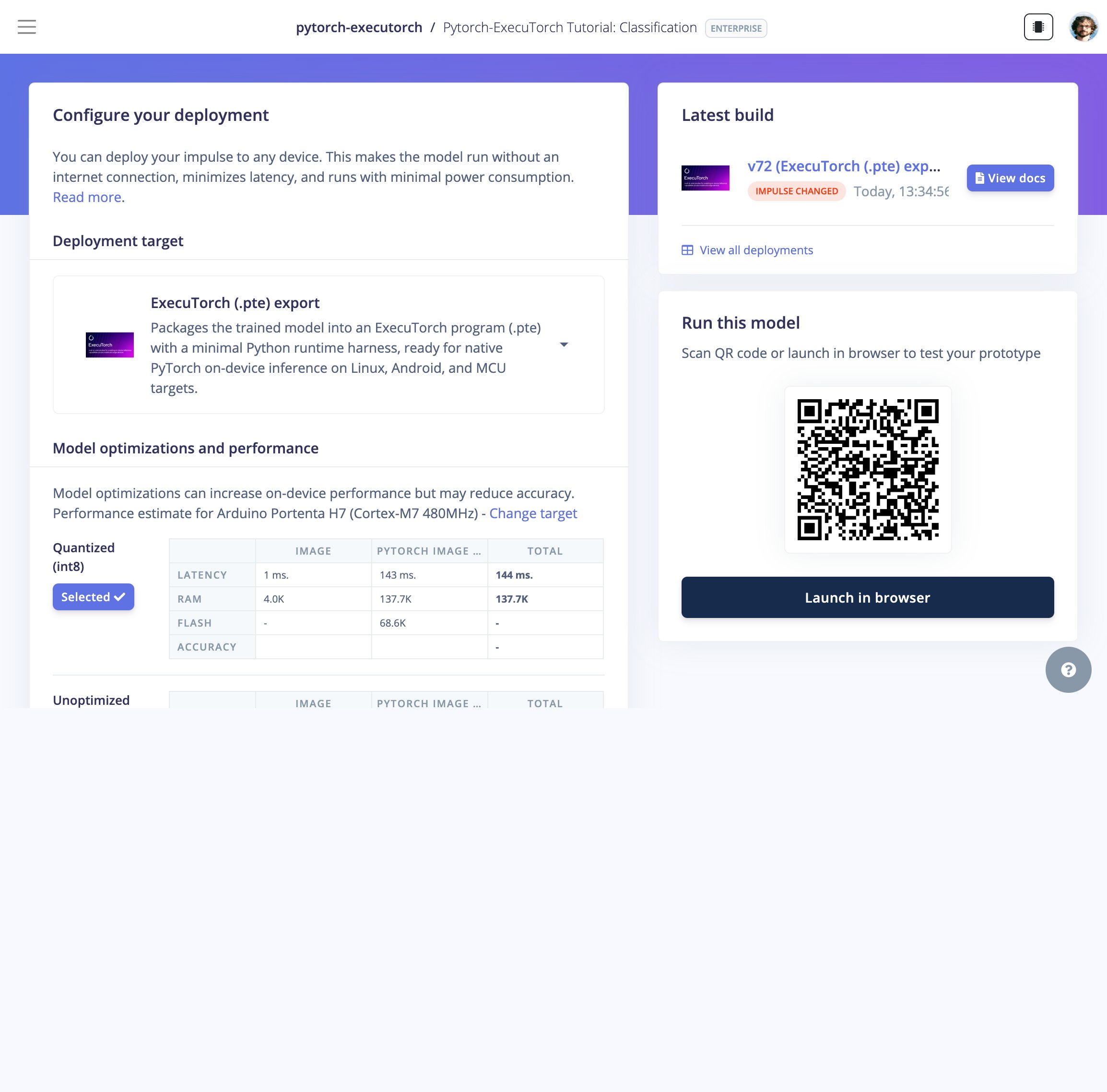
The trained impulse's Deployment page, with the ExecuTorch .pte export target
Run the ExecuTorch program
On a Linux or ARM target with the ExecuTorch Python runtime installed, load the.pte and run a forward pass:
Source code
Every block in this series is open source. The learning block comes in four modality variants that share the same structure. Pick the one that matches your data. They all export an ONNX model for Studio plus an optional ExecuTorch.pte.
Try it on Android
The ExecuTorch Android demo loads a bare.pte and runs it on-device with the XNNPACK CPU backend, with no Edge Impulse C++ SDK and no TFLite. Each block’s DSP (image scaling, motion spectral analysis, audio MFE) is hand-ported to Kotlin so the .pte only runs the neural network. Every product flavor bundles a different exported model under its own app id, so you can install them side by side.
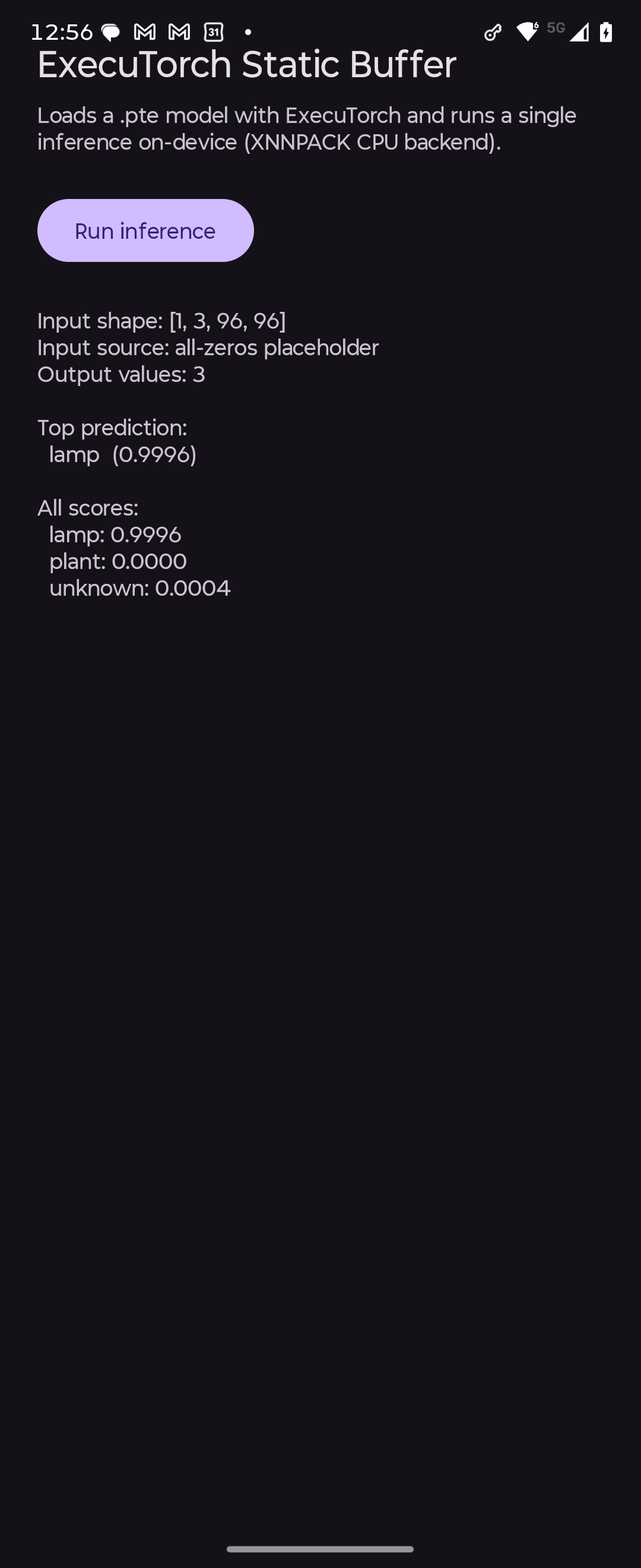
Static-buffer: one forward pass over a fixed input buffer

Image classification running live on-device
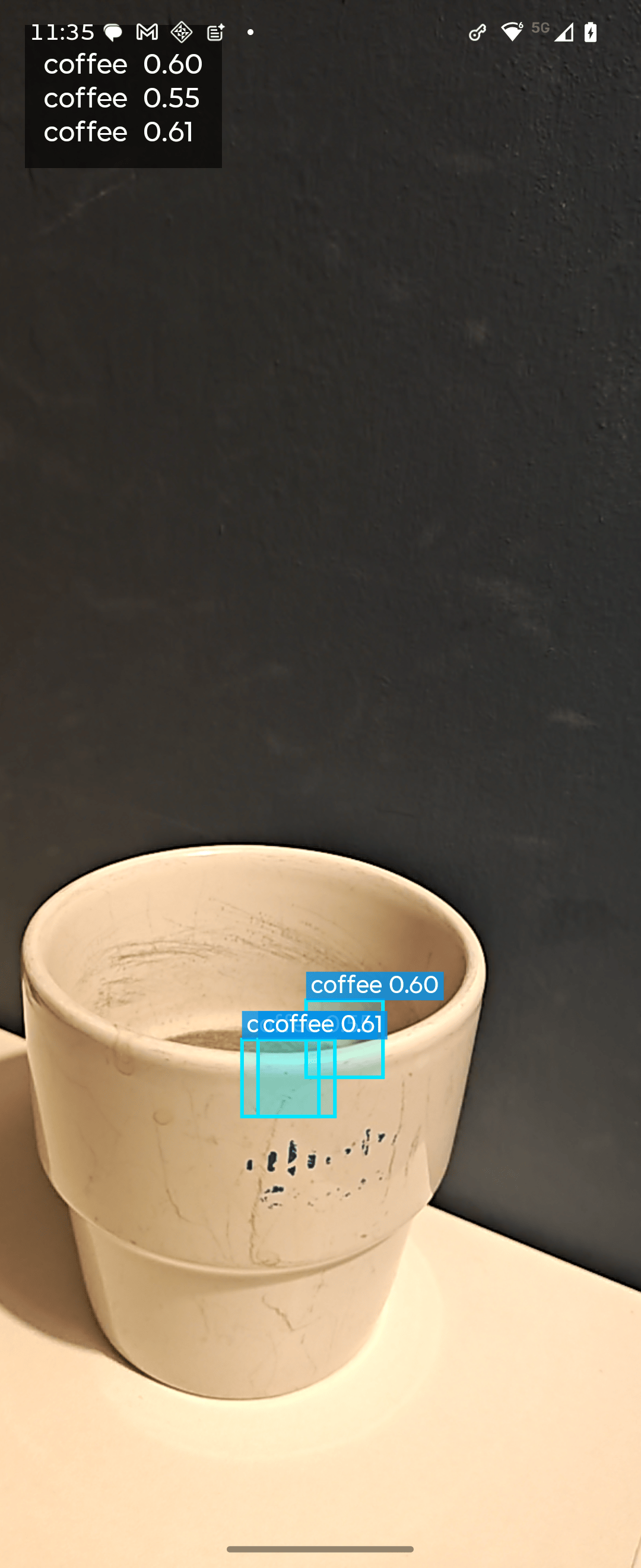
FOMO object detection running live on-device
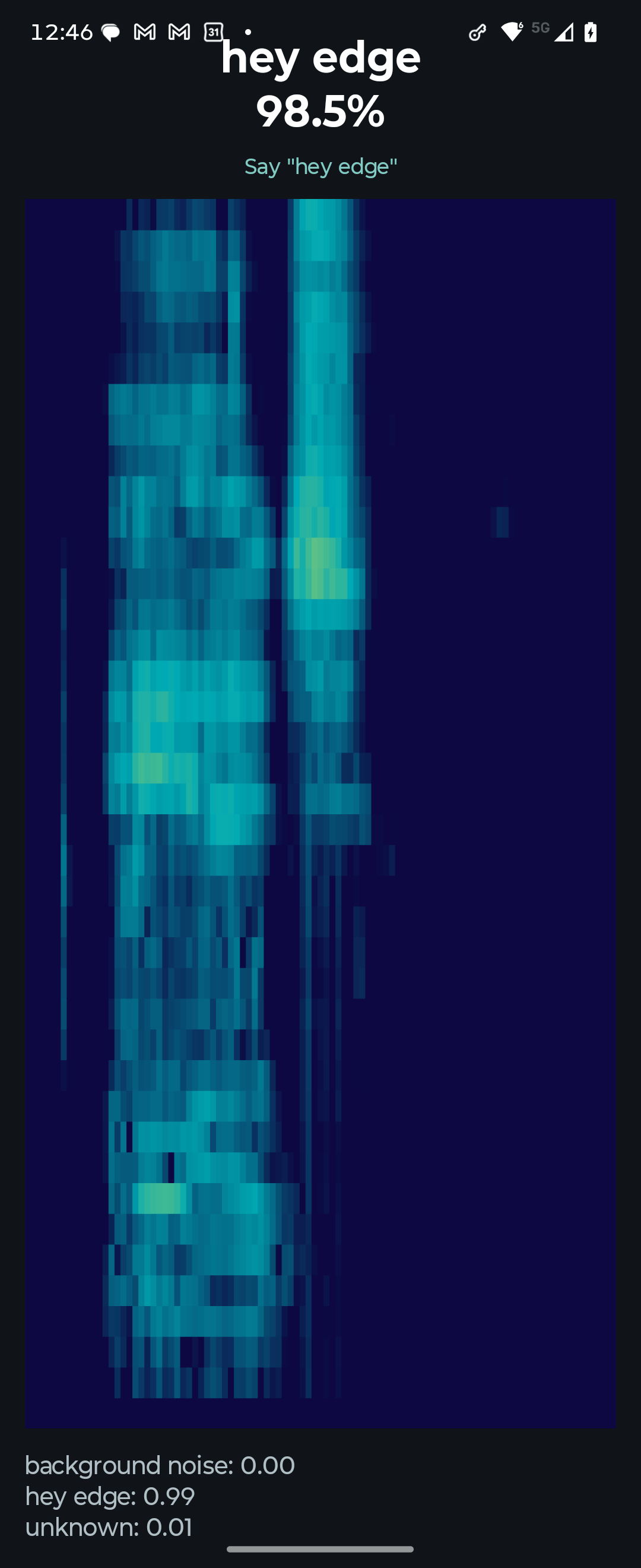
Keyword spotting: live mic through the Kotlin MFE
Extending to the Edge Impulse C++ SDK (later work). This demo runs a bare
.pte and hand-ports each block’s DSP to Kotlin, so every new modality means re-implementing signal processing by hand. A future iteration could instead reuse Studio’s exact DSP by linking the Edge Impulse C++ SDK through JNI. That would involve exporting the full impulse as a C++ library, cross-compiling the SDK for Android (arm64-v8a) with the NDK, and calling run_classifier over a JNI bridge so raw sensor data flows straight into the SDK’s DSP, removing the hand-ported Kotlin code entirely. You would then decide whether ExecuTorch still runs the neural network (SDK for DSP only) or the SDK handles both, and reconcile the input scaling and tensor layout between the two paths. See example-android-inferencing for a JNI-based reference.