 **INTEL CORE ULTRA PERFORMANCE**
The Helix 521 is powered by Intel Core Ultra processing (Core Ultra Series 2 coming soon), designed specifically for edge AI performance and scalability. The system supports up to 96 GB of DDR5 memory for efficient operation and offers storage options including an M.2 2280 M-Key slot (PCIe 4, SATA III). The system is vPro-capable (depending on the CPU selected), enabling remote KVM access and firmware updates.
**ENGINEERED FOR INDUSTRIAL ENVIRONMENTS**
The Helix 521 features a fanless design and a low-profile form factor optimized for DIN, Wall, Vesa and even rack mounting, making it suitable for space-constrained industrial settings. The system is UL, RoHS, FCC, and CE certified, has been EMC tested for industrial, medical, in-vehicle, rail, and maritime applications, and has an operating temperature range of 0 to 50°C.
**VERSATILE CONNECTIVITY FOR INDUSTRIAL NEEDS**
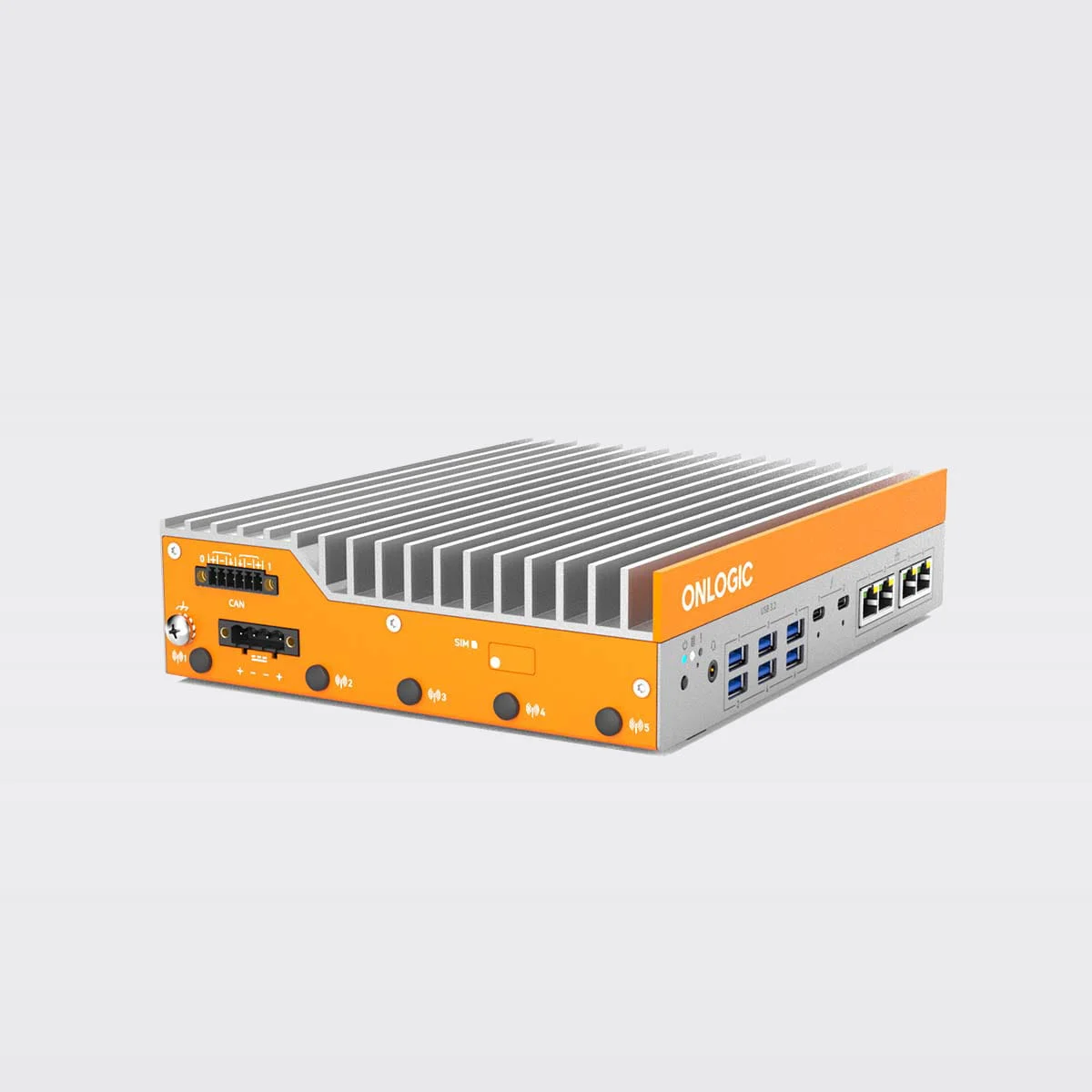
The Helix 521 offers a range of interfaces to support various industrial applications. The front panel includes 4x 2.5GbE LAN, 6x USB 3.2 ports and 2x USB-C/Thunderbolt 4 ports. The side panel offers optional 4x COM ports (RS232/422/485), optional CAN, optional DIO, and 2x Display Ports.
**CELLULAR CONNECTIVITY**
This system can be configured with an integrated cellular modem, pre-certified to operate on many of the world’s most popular cellular carrier networks using a SIM card. Our 4G/5G capable hardware is ideal for today's mobile, edge computing, and Industrial Internet of Things (IIoT) applications. The wireless connectivity has been tested to operate reliably in challenging Electromagnetic Compatibility (EMC) environments (EN 300 328, EN 301 908-2, EN 301 489-17, EN 301 489-52). Many of our systems also include co-location options allowing you to implement Wi-Fi and Bluetooth, in addition to cellular connectivity, at the same time. To take advantage of cellular connectivity, simply configure your system with one of our available cellular modems and then contact your carrier to activate.
**INTEL CORE ULTRA PERFORMANCE**
The Helix 521 is powered by Intel Core Ultra processing (Core Ultra Series 2 coming soon), designed specifically for edge AI performance and scalability. The system supports up to 96 GB of DDR5 memory for efficient operation and offers storage options including an M.2 2280 M-Key slot (PCIe 4, SATA III). The system is vPro-capable (depending on the CPU selected), enabling remote KVM access and firmware updates.
**ENGINEERED FOR INDUSTRIAL ENVIRONMENTS**
The Helix 521 features a fanless design and a low-profile form factor optimized for DIN, Wall, Vesa and even rack mounting, making it suitable for space-constrained industrial settings. The system is UL, RoHS, FCC, and CE certified, has been EMC tested for industrial, medical, in-vehicle, rail, and maritime applications, and has an operating temperature range of 0 to 50°C.
**VERSATILE CONNECTIVITY FOR INDUSTRIAL NEEDS**
The Helix 521 offers a range of interfaces to support various industrial applications. The front panel includes 4x 2.5GbE LAN, 6x USB 3.2 ports and 2x USB-C/Thunderbolt 4 ports. The side panel offers optional 4x COM ports (RS232/422/485), optional CAN, optional DIO, and 2x Display Ports.
**CELLULAR CONNECTIVITY**
This system can be configured with an integrated cellular modem, pre-certified to operate on many of the world’s most popular cellular carrier networks using a SIM card. Our 4G/5G capable hardware is ideal for today's mobile, edge computing, and Industrial Internet of Things (IIoT) applications. The wireless connectivity has been tested to operate reliably in challenging Electromagnetic Compatibility (EMC) environments (EN 300 328, EN 301 908-2, EN 301 489-17, EN 301 489-52). Many of our systems also include co-location options allowing you to implement Wi-Fi and Bluetooth, in addition to cellular connectivity, at the same time. To take advantage of cellular connectivity, simply configure your system with one of our available cellular modems and then contact your carrier to activate.
| System | |
|---|---|
| Hardware Line | Industrial (Fanless) |
| Cooling Type | Fanless |
| Processor Socket | Onboard (BGA) |
| Processor Generation | Intel® Core™ Ultra Processor (Series 1) \[Meteor Lake] |
| Processor | Intel® Core™ Ultra 5 125H Intel® Core™ Ultra 5 135H Intel® Core™ Ultra 7 165H |
| Processor Family | Intel Core Ultra Series 1 & 2 (Meteor and Arrow Lake) |
| Processor Features | AMT Support Embedded Lifecycle Intel vPro® |
| Processor TDP | 28 |
| LAN Controller | Intel® I226LM Intel® I226V |
| Graphics/GPU | Intel ARC Graphics |
| Memory Type | DDR5 |
| Memory Capacity | 96 |
| Memory Clock Speed | 5600 |
| Memory Channels | Dual Channel |
 ### Next steps: building a machine learning model
With everything set up you can now build your first machine learning model with these tutorials:
* [Keyword spotting](/tutorials/end-to-end/keyword-spotting)
* [Sound recognition](/tutorials/end-to-end/sound-recognition)
* [Image classification](/tutorials/end-to-end/image-classification)
* [object detection](/tutorials/end-to-end/object-detection-bounding-boxes)
* [Object detection with centroids (FOMO)](/tutorials/end-to-end/object-detection-centroids) Looking to connect different sensors? Our [Linux SDK](/tools/libraries/sdks/inference/linux) lets you easily send data from any sensor and any programming language (with examples in Node.js, Python, Go and C++) into Edge Impulse.
### Deploying back to device
To run your impulse locally run on your OnLogic Helix 521:
```
edge-impulse-linux-runner
```
This will automatically compile your model with full hardware acceleration, download the model to your local machine, and then start classifying. Our [Linux SDK](/tools/libraries/sdks/inference/linux) has examples on how to integrate the model with your favourite programming language.
#### Image model?
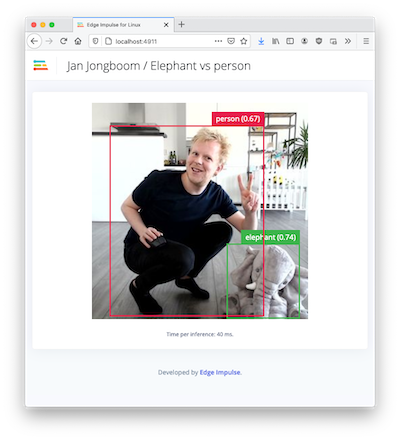
If you have an image model then you can get a peek of what your device sees by being on the same network as your device, and finding the 'Want to see a feed of the camera and live classification in your browser' message in the console. Open the URL in a browser and both the camera feed and the classification are shown:
### Next steps: building a machine learning model
With everything set up you can now build your first machine learning model with these tutorials:
* [Keyword spotting](/tutorials/end-to-end/keyword-spotting)
* [Sound recognition](/tutorials/end-to-end/sound-recognition)
* [Image classification](/tutorials/end-to-end/image-classification)
* [object detection](/tutorials/end-to-end/object-detection-bounding-boxes)
* [Object detection with centroids (FOMO)](/tutorials/end-to-end/object-detection-centroids) Looking to connect different sensors? Our [Linux SDK](/tools/libraries/sdks/inference/linux) lets you easily send data from any sensor and any programming language (with examples in Node.js, Python, Go and C++) into Edge Impulse.
### Deploying back to device
To run your impulse locally run on your OnLogic Helix 521:
```
edge-impulse-linux-runner
```
This will automatically compile your model with full hardware acceleration, download the model to your local machine, and then start classifying. Our [Linux SDK](/tools/libraries/sdks/inference/linux) has examples on how to integrate the model with your favourite programming language.
#### Image model?
If you have an image model then you can get a peek of what your device sees by being on the same network as your device, and finding the 'Want to see a feed of the camera and live classification in your browser' message in the console. Open the URL in a browser and both the camera feed and the classification are shown: